Computational framework
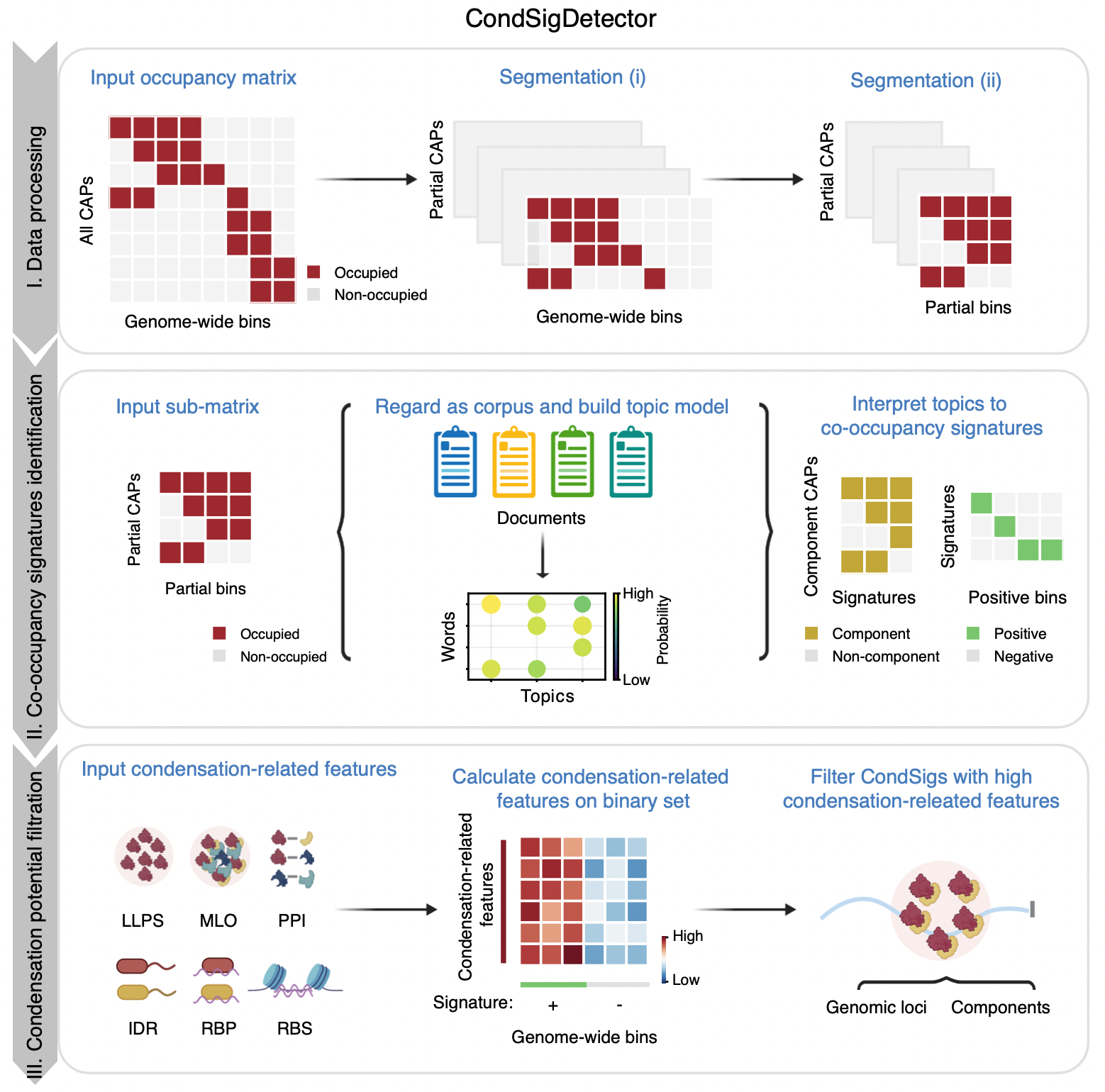
In the first step, CondSigDetector applies an iterative segmentation method, which segments the entire occupancy matrix into smaller sub-matrices. In the second step, CondSigDetector utilizes a topic model to identify co-occupancy signatures of CAPs, which represent high-frequent CAP collaborations, from the sub-matrices. And in the third step, CondSigDetector predicts CondSigs by evaluating the condensation potential for each co-occupancy signature of CAPs identified in the second step.
Prediction
Following stringent quality control, we gathered qualified ChIP-seq data for 189 CAPs in mESC (mESC_dataset_meta.txt) and 216 CAPs in K562 (K562_dataset_meta.txt). Due to the lack of qualified RNA-binding profile for mESC, the RNA binding strength, one of the condensation-related features, was not included in mESC. We identified 25 promoter CondSigs (mESC_promoter_CondSigs.txt) and 36 non-promoter CondSigs (mESC_nonpromoter_CondSigs.txt) in mESC, along with 75 promoter CondSigs (K562_promoter_CondSigs.txt) and 93 non-promoter CondSigs (K562_nonpromoter_CondSigs.txt) in K562.
And we identified 14,345 promoter CondSig-positive sites (mESC_promoter_CondSig_pos_sites.bed.gz) and 24,500 non-promoter CondSig-positive sites (mESC_nonpromoter_CondSig_pos_sites.bed.gz) in mESC, along with 14,201 (K562_promoter_CondSig_pos_sites.bed.gz) and 38,963 (K562_nonpromoter_CondSig_pos_sites.bed.gz) CondSig-positive sites in K562.
And we identified 10,509 promoter high-confidence condensate-related sites (mESC_promoter_condensate_sites.bed.gz) and 4,794 non-promoter high-confidence condensate-related sites (mESC_nonpromoter_condensate_sites.bed.gz) in mESC, along with 5,957 (K562_promoter_condensate_sites.bed.gz) and 10,053 (K562_nonpromoter_condensate_sites.bed.gz) high-confidence condensate-related sites in K562.